


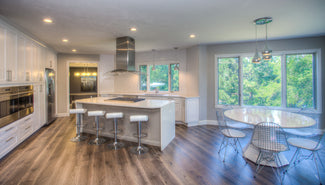
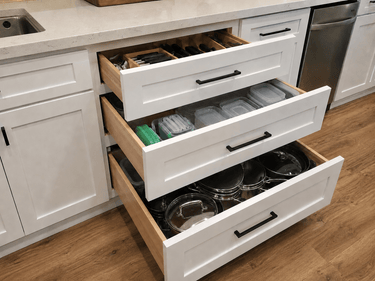
Base kitchen cabinets with drawers can make everyday kitchen storage easier to use. Instead of bending down and reaching into the back of a deep shelf, drawers bring pots, pans, utensils, containers, and tools forward where you can see them.
That does not mean every lower cabinet should be a drawer cabinet. A practical base cabinet layout usually combines drawer bases, door bases, sink bases, pull-outs, corner cabinets, and appliance openings.
If you are ordering RTA kitchen cabinets online, the goal is to choose the right cabinet type for each storage zone. Before choosing drawer bases, it helps to know which areas benefit from drawers and which areas still need doors, pull-outs, or specialty cabinets.
Quick Answer: Are Drawer Base Cabinets Better Than Door Base Cabinets?
Drawer base cabinets are often better for everyday access. They work well for cookware, food containers, utensils, baking tools, dish towels, mixing bowls, and small kitchen items that need to be easy to see and reach.
Door base cabinets are still useful when the cabinet needs an open interior. They are often used for sink plumbing, larger items, lazy Susan corner cabinets, blind corner cabinets, trash pull-outs, and storage accessories.
For most DIY kitchen remodels, the best layout uses a mix:
- Drawer bases for easy-access storage and cooking zones.
- Door bases for larger items, plumbing, and open interior storage.
- Pull-outs for narrow spaces, spices, oils, trays, and trash.
- Corner cabinets for 90-degree corner storage.
- Sink bases for plumbing and under-sink storage.
Drawer Base Cabinet Size Chart
Most standard kitchen base cabinets are about 34-1/2 inches high and 24 inches deep. Drawer base widths vary by cabinet line, but common planning widths include 12, 15, 18, 21, 24, 27, 30, and 36 inches.
| Drawer Base Width | Best Use | Planning Notes |
|---|---|---|
| 12"–15" | Small utensils, towels, narrow storage, compact kitchen runs | Useful in tight layouts but limited for cookware |
| 18" | Utensils, wraps, smaller containers, baking tools | A practical narrow drawer stack for many kitchens |
| 21"–24" | Everyday drawer storage, small pots, containers, prep tools | One of the most versatile drawer base ranges |
| 27"–30" | Cookware, mixing bowls, pans, larger storage zones | Good near ranges, islands, and prep areas |
| 33"–36" | Large cookware, wide drawers, island storage | Very useful, but drawer weight and organization matter |
Use this chart to narrow down the drawer base width, then check the actual drawer configuration on the product page. A cabinet with the same outside width can still have a different drawer layout, drawer depth, or interior storage space.
If you want a second reference for standard cabinet sizes, The Spruce provides a standard kitchen cabinet dimensions guide. Use outside references as a planning starting point, then confirm the exact width, height, depth, and drawer configuration on each cabinet product page before ordering.
What Is a Base Cabinet With Drawers?
A base cabinet with drawers is a lower cabinet that uses drawers instead of, or in addition to, doors. A common drawer base has three drawers: a shallower top drawer and deeper lower drawers.
Some cabinets may have two drawers, four drawers, a drawer-and-door combination, or a specialty pull-out organizer. The right choice depends on what you plan to store and where the cabinet sits in the kitchen.
Base cabinet dimensions are usually written as:
Width x Height x Depth
For example, a 24-inch drawer base may be listed as 24"W x 34-1/2"H x 24"D. That means the cabinet is 24 inches wide, 34-1/2 inches high, and 24 inches deep.
If you are still confirming cabinet height or depth, read our standard kitchen cabinet height guide and kitchen cabinet depth guide before finalizing the cabinet list.
When comparing drawer bases, do not look only at the outside width. A 24-inch drawer base does not give you a 24-inch wide drawer interior because the frame, drawer slides or glides, drawer box thickness, and operating clearance all take up space.
Best Places to Use Drawer Base Cabinets
Drawer bases work best where you reach often during cooking, prep, and cleanup. In a busy kitchen, this usually means prep areas, cooking zones, islands, and storage zones near the dishwasher.
Near the Range or Cooktop
Drawer base cabinets near the range are useful for pots, pans, lids, cooking utensils, oven mitts, and baking sheets. Deep lower drawers can be easier to use than a door cabinet because you can pull the drawer out and see everything at once.

Near the Prep Area
A drawer base near the main prep counter can store knives, cutting boards, mixing bowls, measuring cups, food wrap, towels, and small tools. This keeps the items you use during prep within one step of the counter.
Near the Dishwasher
Drawer bases near the dishwasher can hold plates, bowls, storage containers, or dish towels. This makes unloading easier because items are stored close to where they are cleaned.
In a Kitchen Island
Kitchen islands are often a strong place for drawer bases. Drawers make island storage easier to use from the working side of the kitchen.
They are also helpful for cookware, lunch containers, baking supplies, serving pieces, and kids’ dishes.

When Door Base Cabinets Still Make Sense
Door bases are still useful when the cabinet needs an open interior. They can handle storage situations where a stacked drawer layout is not the best fit.
Use door base cabinets when you need:
- Open storage for large items
- Sink plumbing access
- A garbage disposal or water filter area
- A lazy Susan corner base
- A blind corner cabinet
- A cabinet for pull-out trash or recycling
- Roll-out trays added inside a door cabinet
For example, a sink base is not usually planned like a regular drawer base because the sink bowl and plumbing need space inside the cabinet. If you are planning a sink area, read our sink base cabinet dimensions guide before finalizing the cabinet list.
Pull-Out Base Cabinets: Narrow Storage That Works Hard
Pull-out base cabinets are useful when you have a narrow leftover space in the cabinet run. Instead of wasting that space, a pull-out can turn it into storage that is easy to reach.
Pull-outs are often used for:
- Spices and oils
- Baking sheets and cutting boards
- Cooking utensils
- Trash or recycling
- Pantry items
- Narrow utility storage
Common pull-out widths can vary by cabinet line and organizer type. Before choosing one, check both the outside cabinet width and the type of internal organizer included.
For visual examples, you can review pull-out kitchen storage ideas from Better Homes & Gardens. These examples show how pull-outs can be used for spices, cookware, trays, and hidden storage.
Pull-outs are especially helpful when a regular drawer base would be too narrow to use comfortably. They can make a small cabinet space feel more intentional.

Drawer Bases Near Sink, Range and Dishwasher
Good drawer planning follows the kitchen workflow. Do not plan drawer bases only by empty wall space; plan them around cooking, prep, and cleanup zones.
Near the Sink
Place dish towels, cleaning cloths, sponges, wraps, bags, or food storage containers near the sink. These are items people often use during cleanup or food prep.
Avoid putting a drawer base where plumbing access is needed. The sink base itself should be planned around the sink, drain, disposal, and water lines.
Near the Range
Use drawer bases near the range for cookware, lids, utensils, spices, and cooking tools. Store the tools you use while cooking within reach of the range.
Before finalizing the cabinet sequence, check oven door swing and nearby appliance handles so the drawers can still open comfortably.
Near the Dishwasher
Drawer bases near the dishwasher can make unloading easier. If your family stores plates or bowls in lower drawers, this can be more convenient than carrying everything to upper wall cabinets.
Before deciding the exact cabinet sequence, mark the dishwasher door swing, range door swing, and sink location on your layout sketch.
Drawer Bases and Corner Cabinets
Corners need special planning. A drawer base placed too close to a corner can hit the adjacent cabinet, appliance handle, or cabinet hardware if there is not enough filler space.
Common corner solutions include lazy Susan corner base cabinets and blind corner base cabinets. These usually work differently from standard drawer bases.
A lazy Susan uses rotating shelves. A blind corner base extends into the hidden corner area and may use a pull-out organizer.
If your kitchen has an L-shaped corner, read our corner kitchen cabinet dimensions guide before choosing the nearby drawer bases.
When planning drawers near corners, check:
- Drawer opening direction
- Handle projection
- Filler space
- Dishwasher door clearance
- Lazy Susan or blind corner door swing
- Whether two doors or drawer fronts can hit each other
Drawer Base Cabinets for Kitchen Islands
Kitchen islands are often a good place to use drawer base cabinets because island storage is easy to access from the main work zone.
Good island drawer storage can include:
- Pots and pans
- Mixing bowls
- Food containers
- Baking tools
- Kids’ dishes
- Lunch supplies
- Serving pieces
Before adding wide drawer bases to an island, check the aisle clearance around the island and make sure drawers can open fully without blocking major traffic paths.
If your island is also used for seating, plan the seating overhang and drawer access separately.
How to Measure Before Choosing Drawer Base Cabinets
Before ordering cabinets, prepare a simple kitchen sketch. You can use our Kitchen Measuring Guide to record wall lengths, windows, doors, appliances, openings, and obstacles.
For drawer base planning, measure and mark:
- Full wall lengths
- Sink location
- Dishwasher location
- Range and refrigerator location
- Corner cabinet location
- Island or peninsula clearance
- Door and drawer opening paths
- Any pipes, vents, outlets, or access panels
Drawer base widths should be checked against nearby doors, appliances, corners, and walkways. If you are not sure which drawer base widths will work in your kitchen, submit your measurements, sketch, photos, or blueprint through our Free Kitchen Cabinet Design Services.
Common Drawer Layout Mistakes
Most drawer layout mistakes happen when homeowners choose drawer sizes before checking workflow and clearance. The drawer may fit on paper, but still feel awkward once appliances, corners, and walkways are included.
Using drawers everywhere
Drawers are convenient, but not every cabinet should be a drawer base. Sink bases, corner cabinets, and some pull-out trash areas may need door-style or specialty cabinet configurations.
Choosing wide drawers without planning weight
Wide drawers are useful, but they can become heavy when filled with cookware. Use wide drawers thoughtfully and plan organization around realistic daily use.
Putting drawers too close to corners
Drawers near corners need filler and clearance so the drawer front and handle do not hit the adjacent cabinet run. Small spacer pieces may be needed so the drawer can open properly.
Forgetting appliance door swing
Dishwashers, ovens, refrigerators, and pull-out trash cabinets all need room to open. Check the real opening path, not just the cabinet width.
Drawers and appliance doors should not compete for the same open space.
Ignoring the difference between cabinet width and drawer box width
A 24-inch cabinet does not mean the usable drawer box is 24 inches wide. The interior drawer box is smaller because of the frame, glides, and drawer construction.
Not grouping storage by workflow
Drawer bases should support how the kitchen is used. Store cooking tools near the range, prep tools near the prep zone, and dish storage near the dishwasher when possible.
FAQ: Base Kitchen Cabinets With Drawers
Are drawer base cabinets better than door base cabinets?
Drawer base cabinets are often better for easy-access items such as cookware, utensils, containers, and everyday tools. Door base cabinets are still useful for plumbing, corners, large items, trash pull-outs, and specialty storage.
What is the standard size of a drawer base cabinet?
Many drawer base cabinets follow standard base cabinet dimensions: about 34-1/2 inches high and 24 inches deep. Widths vary by cabinet line and commonly include sizes such as 15, 18, 21, 24, 27, 30, and 36 inches.
Where should I put drawer base cabinets in a kitchen?
Good places include prep zones, cooking zones, islands, and areas near the dishwasher. Drawer bases work best where you need frequent access to tools, cookware, or storage containers.
Can I use drawer bases near a corner cabinet?
Yes, but you need to plan filler space, handle clearance, and door swing. A drawer placed too close to a corner can collide with the adjacent cabinet or appliance.
What is the difference between a pull-out and a drawer base?
A drawer base usually has stacked drawers that pull straight out. A pull-out cabinet usually has an internal organizer, rack, trash system, spice pull-out, or tray divider that slides out from inside the cabinet.
Are drawers good for pots and pans?
Yes. Deep lower drawers can be useful for pots, pans, lids, and mixing bowls, especially near the range or island. Use a drawer size and configuration that makes sense for heavier cookware.
Build a Base Cabinet Layout Around Real Storage Zones
Base kitchen cabinets with drawers can make a kitchen more functional when they are placed intentionally. Use drawer bases where they improve access to the items you use often.
Door bases still matter for plumbing, corners, large items, and some specialty pull-outs. Narrow pull-outs can also turn small leftover spaces into useful storage.
Start by planning your sink, range, dishwasher, corners, and island. Then decide where drawer bases will make daily cooking and cleanup easier.