


RTA pantry cabinets are not just tall boxes for extra shelves. They solve a very real kitchen problem: how to add meaningful storage without crowding the countertop or adding more lower cabinets.
Many homeowners do not have a walk-in pantry. Others have enough cabinets on paper, but the kitchen still feels messy because dry goods, small appliances, cookware, cleaning supplies, and bulk items are spread across countertops, base cabinets, and random closets. A tall pantry cabinet can bring that storage into one vertical zone.
For DIY homeowners ordering RTA kitchen cabinets online, the goal is not simply to choose the tallest cabinet available. The real goal is to decide where a tall cabinet can make the kitchen easier to use without blocking work areas, appliance doors, or natural traffic flow.

Quick Answer: What Problems Do Pantry Cabinets Solve?
An RTA pantry cabinet is a ready-to-assemble tall kitchen cabinet used for full-height storage. It can store food, cookware overflow, cleaning supplies, small appliances, or household items depending on the cabinet style and interior layout.
Pantry cabinets are most useful when the kitchen has one of these problems: there is no walk-in pantry, the countertop is crowded with small appliances, lower cabinets are being used for food storage instead of cookware, or the refrigerator wall has unused vertical space.
A pantry cabinet works best when it has a clear job. It should not become a random cabinet for everything that does not fit elsewhere. Before choosing one, decide whether it will be used as a food pantry, appliance cabinet, utility cabinet, grocery zone, or full-height storage column.
What Is an RTA Pantry Cabinet?
An RTA pantry cabinet is a tall cabinet that ships ready to assemble and is installed as part of the kitchen cabinet layout. In many cabinet lines, pantry cabinets fall under the broader category of tall cabinets.
Market-wide, tall pantry cabinets commonly come in heights such as 84, 90, and 96 inches. Depths can vary from shallow pantry options to full-depth or deeper appliance cabinets. These numbers matter, but they should not be the first decision. The first decision is what storage problem the cabinet needs to solve.
A tall cabinet used for dry food is different from a tall cabinet used for brooms, mops, and cleaning supplies. An oven pantry cabinet is different again because it must match appliance openings and installation requirements. That is why the cabinet name alone is not enough. You need to look at the interior layout, shelves, doors, depth, and intended use.
When a Pantry Cabinet Makes Sense in a Kitchen

A pantry cabinet makes the most sense when it creates a storage zone that the rest of the kitchen is missing. If your base cabinets are already doing too many jobs, a tall pantry can separate food storage from cookware storage and make the kitchen easier to organize.
One common example is a kitchen without a pantry closet. In that case, a tall cabinet can act as a built-in pantry without requiring a separate room. This is especially useful for homeowners who buy groceries in larger quantities but do not want dry goods spread across several wall cabinets.
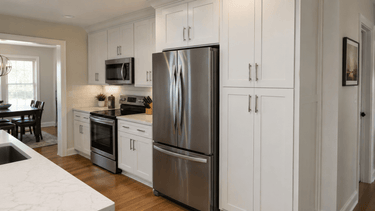
Another strong use is beside the refrigerator. When a pantry cabinet sits near the fridge, the kitchen gains a clear food storage area: cold food in the refrigerator, dry food in the pantry, and ideally a nearby counter for unloading groceries. This works better than scattering food storage across unrelated cabinets.
A pantry cabinet can also work well at the end of a cabinet run. Instead of the kitchen ending with a short base cabinet or an awkward open side, the tall cabinet gives the run a finished vertical endpoint. This can make the layout feel more intentional, especially in an L-shaped or straight-line kitchen.
In a small kitchen, a pantry cabinet can be helpful because it uses height instead of floor area. But it needs to be placed carefully. A tall cabinet in the wrong spot can make a small kitchen feel tighter, especially if it breaks up the main prep counter or blocks light from a window.
Shallow vs Full-Depth Pantry Cabinets: Which Is Easier to Live With?
Pantry cabinet depth changes how the cabinet feels in daily use. A shallow pantry stores less, but it can be easier to live with because most items stay visible. If your main frustration is losing cans, jars, and small packages in the back of deep shelves, a shallow pantry can be more practical than a larger full-depth cabinet.
A full-depth pantry stores more, but it needs better organization. Deep shelves can quickly become a storage black hole if everything is stacked in rows. The back of the cabinet becomes hard to see, and homeowners may end up buying duplicates because they forget what is already inside.
That does not mean full-depth pantry cabinets are bad. They are excellent for larger items, small appliances, deep bins, bulk goods, and cookware overflow. The key is to treat a deep pantry differently from a shallow pantry. Use bins, baskets, pull-outs, labeled zones, or shelf categories so the extra depth becomes useful instead of frustrating.
For general cabinet dimension references, The Spruce offers a standard kitchen cabinet dimensions guide. Use outside size guides as a starting point, then confirm the exact cabinet dimensions on each product page before ordering.
How to Use a Tall Pantry Cabinet Without Crowding the Kitchen
The biggest mistake with tall cabinets is placing them where the kitchen needs open counter space. A pantry cabinet adds storage, but it also interrupts the countertop run. That can be helpful at the end of a run, but frustrating in the middle of a prep area.
A good pantry location should support the kitchen workflow. If the cabinet is used for food storage, it should be near the refrigerator, cooking zone, or grocery unloading area. If it is used for utility storage, it may work better near a mudroom, laundry area, garage entry, or side wall.
Think of the pantry cabinet as a storage anchor. It should give the kitchen structure. It should not feel like a tall block randomly inserted into the most useful counter area.
In small kitchens, one well-placed pantry cabinet can be better than several scattered storage pieces. But the cabinet should not narrow the main walkway, block an appliance door, or make the room feel visually heavy. If the kitchen already feels tight, a narrower or shallower tall cabinet may work better than a full-depth cabinet.
Pantry Cabinets Near Refrigerators, Ovens and Coffee Stations

A pantry beside the refrigerator works best when it behaves like part of a food storage zone. The refrigerator handles cold storage, the pantry handles dry storage, and the nearby counter becomes the place to unload groceries or prepare simple meals.
The problem comes when the refrigerator door, pantry door, handles, and walkway all compete for the same space. A pantry cabinet can technically fit on a wall and still feel wrong if the doors are awkward to use. This is why refrigerator-side pantry cabinets should be planned with door swing, handle projection, fillers, and walkway space in mind.
Oven pantry cabinets need even more caution. Not every tall pantry cabinet can become an oven cabinet. An oven pantry cabinet must be designed for an appliance opening, and the oven or microwave must match the required size, ventilation, and installation specifications. If the appliance does not match the cabinet opening, the cabinet is not the right choice.
A pantry cabinet can also support a coffee station. In that case, the tall cabinet does not need to store everything. It may hold mugs, coffee supplies, filters, syrups, breakfast items, or small appliances near a short base cabinet or countertop area. This works especially well when the pantry cabinet supports a clear daily routine instead of becoming general overflow storage.
What Should Go in a Pantry Cabinet — and What Should Stay in Base Cabinets?

A pantry cabinet works best for items that benefit from vertical organization. Dry food, pantry overflow, light appliances, paper goods, cleaning products, and household supplies can all work well depending on the cabinet type.
Heavy cookware is not always the best use of a tall pantry cabinet. Pots, pans, lids, and mixing bowls are often easier to store in drawer base cabinets near the range or island because drawers bring heavy items forward. If you store heavy cookware in a tall cabinet, keep it in the lower section so it is safer and easier to reach.
Small appliances can work well in a pantry cabinet, but only if the shelves are deep and strong enough for the items you plan to store. A stand mixer, air fryer, toaster oven, or pressure cooker should not be placed so high that it becomes difficult or unsafe to lift down.
Cleaning supplies should be separated from food storage when possible. If one tall cabinet is doing both jobs, use separate shelves or zones so food items and household chemicals do not feel mixed together. A utility-style tall cabinet may be better than a food pantry if the main need is brooms, mops, vacuums, and cleaning products.
The best kitchen storage plan usually combines several cabinet types. Pantry cabinets handle vertical storage. Drawer bases handle cookware and everyday tools. Door bases handle larger items, sink areas, trash systems, and some corner solutions. For lower cabinet planning, read our base kitchen cabinets with drawers guide.
How to Plan Pantry Storage for a Small Kitchen
In a small kitchen, a pantry cabinet should solve clutter, not create a new obstacle. The best location is often at the end of a cabinet run, beside the refrigerator, or on a side wall where full-height storage does not interrupt the main prep counter.
If the kitchen is narrow, a shallow pantry may be more useful than a full-depth one. It will not hold as much, but it can keep everyday food visible and preserve more walkway space. In a compact kitchen, easy access can matter more than maximum storage volume.
Be careful with tall cabinets near windows. A pantry cabinet can block natural light or make one side of the kitchen feel heavy. If the kitchen already lacks light, placing tall cabinets together on one wall may work better than spreading them around the room.
If the pantry sits near an L-shaped corner or turns the cabinet run, review our corner kitchen cabinet dimensions guide before finalizing the layout.
Common Pantry Cabinet Planning Mistakes
Choosing a pantry cabinet only because it is tall
More height does not automatically mean better storage. A pantry cabinet should match what you plan to store, how often you use those items, and where the cabinet sits in the kitchen workflow.
Using a deep pantry without an organization plan
A deep cabinet can hold more, but it can also hide more. If you choose a full-depth pantry, plan shelf zones, bins, baskets, or pull-outs before the cabinet becomes hard to manage.
Placing the pantry in the middle of the best prep area
A tall cabinet breaks the countertop. This can be fine at the end of a run, but it can be frustrating if it removes the most useful work surface in the kitchen.
Treating an oven pantry like a regular pantry
An oven pantry cabinet is an appliance cabinet first. The opening, ventilation, electrical requirements, and appliance installation instructions matter more than the general pantry look.
Not telling the design team what the pantry needs to store
A pantry for dry food, a pantry for small appliances, and a utility cabinet for cleaning supplies may require different cabinet choices. Explain the storage goal before the cabinet list is finalized.
How to Plan Before Ordering a Pantry Cabinet
Before ordering a pantry cabinet, start with the storage problem, not the cabinet size. Decide what currently has no good home in the kitchen. Is it dry food? Small appliances? Bulk items? Cleaning supplies? Cookware overflow? Brooms and mops?
Next, decide where that storage belongs in the workflow. Food storage often belongs near the refrigerator or cooking zone. Utility storage may belong closer to a side wall, mudroom, laundry area, or garage entry. Small appliances may belong near an outlet and a short landing counter.
Then check the physical layout. Measure ceiling height, wall length, refrigerator location, door swing, walkway clearance, nearby island space, outlets, switches, soffits, and appliance openings. You can use our Kitchen Measuring Guide to prepare a sketch and photos before requesting a quote.
For broader clearance planning, the NKBA kitchen planning guidelines are a useful outside reference for appliance locations, walkways, work areas, and accessibility. Your final cabinet list should still be based on your actual measurements and cabinet specifications.
FAQ: RTA Pantry Cabinets
What is an RTA pantry cabinet?
An RTA pantry cabinet is a ready-to-assemble tall cabinet used for full-height kitchen storage. It can store food, small appliances, cookware overflow, cleaning supplies, or utility items depending on the cabinet type.
Is a pantry cabinet the same as a tall cabinet?
A pantry cabinet is a type of tall cabinet. Tall cabinet is the broader category. Pantry cabinet usually means tall storage used for food, kitchen overflow, or household storage.
Where should a pantry cabinet go in a kitchen?
A pantry cabinet often works well beside the refrigerator, at the end of a cabinet run, in a pantry wall, near a cooking zone, or in a utility area. The best location depends on what you store and how the cabinet affects countertop space, appliance doors, and walkways.
Is a shallow pantry better than a deep pantry?
A shallow pantry is often easier for everyday food storage because items stay visible. A deep pantry stores more and works better for bulk items or small appliances, but it needs better organization so items do not disappear in the back.
Can I use a pantry cabinet for small appliances?
Yes, if the cabinet depth, shelf strength, and shelf height work for the appliance. Heavy appliances should usually be stored lower so they are easier and safer to lift.
Can I use a tall pantry cabinet for an oven or microwave?
Only if the cabinet is designed as an oven pantry or appliance cabinet and the appliance matches the required opening. Do not assume a regular pantry cabinet can be used for an oven.
Can RTA Cabinets House help me choose a pantry cabinet?
Yes. Submit your measurements, photos, sketch, ceiling height, refrigerator location, and storage goals through our Free Kitchen Cabinet Design Services page so the cabinet list can account for layout, storage needs, and cabinet placement.
Use Tall Cabinets to Create Storage, Not Clutter
A good pantry cabinet does more than add shelves. It gives the kitchen a clear storage zone. It can replace a missing pantry closet, reduce countertop clutter, organize dry food, hold small appliances, or create a finished end to a cabinet run.
The best pantry cabinet is not always the tallest or deepest one. It is the one that fits the way you cook, shop, unload groceries, store appliances, and move through the kitchen.
Explore our tall cabinets, compare cabinet styles such as White Shaker RTA cabinets, or request a Free Kitchen Cabinet Design & Quote if you want help deciding where a pantry cabinet should go in your layout.