


Planning a DIY kitchen remodel usually starts with cabinet sizes, not cabinet colors. Before you place an order or request a kitchen cabinet quote, you need to understand standard kitchen cabinet height and how each cabinet type fits into the room.
Base cabinets, wall cabinets, and tall cabinets all follow different size rules. Choosing the wrong height can affect countertop comfort, appliance openings, upper cabinet clearance, and the overall kitchen layout.
This guide explains the standard height for base, wall, and tall kitchen cabinets, how these cabinet types work together, and what DIY homeowners should measure before ordering RTA kitchen cabinets online.
Quick Answer: What Is the Standard Kitchen Cabinet Height?
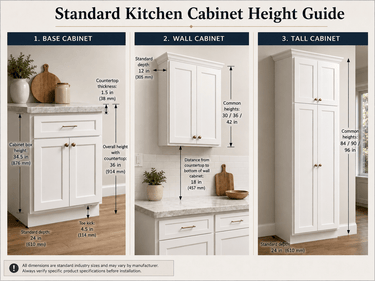
- Base cabinets: usually 34-1/2 inches high without a countertop. After the countertop is installed, the finished height is typically about 36 inches.
- Wall cabinets: commonly available in 12, 15, 18, 24, 30, 36, and 42 inches, depending on the layout and storage needs.
- Tall cabinets: commonly available in 84, 90, and 96 inches. These are often used for pantry cabinets, utility cabinets, and full-height storage.
Before you order: Always check the exact product page. Cabinet dimensions are usually shown as width x height x depth, and different cabinet types may have different depths or installation requirements.
Standard Kitchen Cabinet Height Chart
| Cabinet Type | Common Height | Common Depth | Common Use |
|---|---|---|---|
| Base Cabinets | 34.5" without countertop; about 36" finished height | 24" | Lower cabinets for countertops, sinks, drawers, and appliances |
| Wall Cabinets | 12", 15", 18", 24", 30", 36", and 42" | 12" | Upper storage for dishes, glassware, dry goods, and everyday items |
| Tall Cabinets | 84", 90", and 96" | Often 24", depending on style | Pantry, broom, utility, or full-height kitchen storage |
Use this chart to narrow down the size range first. Your final cabinet list should still be based on room measurements, ceiling height, appliance locations, and the cabinet style you plan to order.
What Does Cabinet Height Mean?
Cabinet dimensions are usually written in this order:
Width x Height x Depth
For example, a cabinet listed as 30"W x 34-1/2"H x 24"D is 30 inches wide, 34-1/2 inches high, and 24 inches deep.
When you are browsing product pages, the middle number is usually the height. That number helps you check whether the cabinet will fit under a countertop, above a counter, or in a full-height pantry area.
For DIY homeowners, cabinet height affects more than appearance. It can affect countertop comfort, upper cabinet clearance, crown molding, soffits, pantry alignment, and appliance fit.
Standard Base Cabinet Height
Standard base cabinets are typically 34-1/2 inches high before the countertop is installed. Once the countertop is added, the finished working height is usually around 36 inches.
Base cabinets sit on the floor and support the countertop. They are used for sink areas, drawer storage, trash pull-outs, corner storage, dishwashers, ranges, and other lower kitchen sections.
Common Base Cabinet Dimensions
- Height: 34-1/2"
- Depth: 24"
- Common widths: 9", 12", 15", 18", 21", 24", 27", 30", 33", 36", 39", and 42"
A 24-inch base cabinet depth is common because it gives you usable storage while keeping the countertop comfortable to reach. If a base cabinet is too deep, small items can get lost in the back. If it is too shallow, you may lose storage and countertop support.
Not every cabinet style carries every width. Always confirm the exact size on the product page before building your cabinet list.
Why 34-1/2 Inches Matters
The 34-1/2 inch height is designed to work with a countertop. After the countertop is installed, the finished height is typically close to 36 inches.
This matters when you are planning a sink base, dishwasher area, range opening, or long lower cabinet run. A small size mistake in the base cabinet run can affect appliance openings and may force changes to the final cabinet list.
Standard Wall Cabinet Height
Standard wall cabinets, also called upper cabinets, come in several heights. Common wall cabinet heights include 12, 15, 18, 24, 30, 36, and 42 inches.
Wall cabinets are installed above countertops, appliances, or open wall areas. They are usually shallower than base cabinets so homeowners can reach dishes, glassware, and everyday items more easily.
Common Wall Cabinet Dimensions
- Common heights: 12", 15", 18", 24", 30", 36", and 42"
- Common depth: 12"
- Common widths: often 9" to 36", depending on the cabinet line
Wall cabinets are often installed with about 18 inches of clearance between the countertop and the bottom of the upper cabinet. This gives space for food prep, a coffee maker, toaster, small appliances, and everyday counter use.
Shorter wall cabinets are often used above refrigerators, ranges, microwaves, or hood areas, depending on the appliance setup.
How to Choose 30", 36", or 42" Wall Cabinets
Choosing wall cabinet height depends on ceiling height, storage needs, and the look you want for the kitchen.
- 30" wall cabinets can work well when you want more open space above the cabinets or when soffits limit the upper area.
- 36" wall cabinets give you more storage and a taller look without always reaching the ceiling.
- 42" wall cabinets are often used when homeowners want a built-in look or want to reduce the open gap above upper cabinets.
For an 8-foot ceiling, the height calculation is especially important:
- Base cabinet plus countertop: about 36"
- Typical clearance above countertop: about 18"
- Bottom of wall cabinet: about 54" from the floor
- 42" wall cabinet top: about 96" from the floor
This can create a tall, finished look, but it does not work the same way in every kitchen. You still need to account for crown molding, ceiling variation, soffits, and installation details.
Standard Tall Cabinet Height
Tall cabinets are full-height cabinets used for pantry storage, utility storage, linen storage, broom storage, and larger kitchen storage areas. Common tall cabinet heights include 84, 90, and 96 inches.
They are useful when you want more vertical storage without adding more countertop space. A tall pantry cabinet can hold dry goods, small appliances, cleaning supplies, or overflow kitchen items.
Common Tall Cabinet Dimensions
- Common heights: 84", 90", and 96"
- Common widths: often 18", 24", 30", or 33", depending on the cabinet line
- Common depth: often around 24", but exact depth depends on the cabinet style
Because tall cabinets take up a full vertical section of the room, height and depth should be checked carefully. This is especially important if the cabinet will sit near a refrigerator, doorway, ceiling trim, or wall cabinet run.
How Tall Cabinets Align With Wall Cabinets
Once you choose your upper cabinet height, check whether the pantry or utility cabinet should line up with it. A helpful planning rule is to think about the top line of the kitchen.
- 30" wall cabinets often align with an 84" tall cabinet when upper cabinets start around 54" from the floor.
- 36" wall cabinets often align with a 90" tall cabinet.
- 42" wall cabinets often align with a 96" tall cabinet.
This is not a universal rule for every kitchen. Crown molding, uneven ceilings, soffits, and staggered cabinet designs can all change how the top line should be planned.
How to Match Base, Wall, and Tall Cabinets in One Kitchen
Many cabinet ordering mistakes happen when base cabinets, wall cabinets, and tall cabinets are planned separately. The layout usually works better when all cabinet types are planned together from the start.
Before ordering, think through these questions:
- Where will the sink base go?
- Where are the refrigerator, range, dishwasher, microwave, and hood?
- Do you want upper cabinets to reach near the ceiling?
- Do you have a soffit, beam, vent, window, or ceiling height change?
- Do you need pantry storage or utility storage?
- Do you want the tops of the wall cabinets and tall cabinets to align?
For many DIY remodels, it helps to plan the kitchen in zones:
- Base cabinet zone: lower storage, drawers, sink, trash pull-out, and countertop support.
- Wall cabinet zone: upper storage for dishes, glassware, dry goods, and everyday items.
- Tall cabinet zone: pantry, utility, broom, linen, or full-height storage.
After the basic layout is clear, you can use 10x10 kitchen cabinet sets as a rough pricing reference. A 10x10 kitchen price is not the final price for every kitchen, but it can help you understand how a basic cabinet package is structured.
How to Measure Before Choosing Cabinet Heights
For general kitchen planning and clearance recommendations, homeowners can also review the NKBA kitchen planning guidelines. These guidelines are useful for understanding broader kitchen layout principles, but your final cabinet list should still be based on your actual room measurements and the exact cabinet dimensions you plan to order.
Before choosing cabinet heights, measure the room instead of only measuring the wall where cabinets will go. Use a simple sketch to record wall lengths, openings, appliances, sink location, and obstacles.
Use the Kitchen Measuring Guide to prepare your sketch before requesting a quote. At minimum, measure and mark:
- Full wall lengths from corner to corner
- Ceiling height
- Window and door openings
- Sink location
- Range, refrigerator, dishwasher, microwave, and hood locations
- Vents, outlets, switches, pipes, soffits, radiators, and access panels
- Any area where the wall is not straight or the floor is uneven
If the ceiling or floor looks uneven, measure in more than one spot. A small difference can affect wall cabinet height, crown molding, or tall cabinet fit.
Photos are also helpful. Take clear photos of corners, appliance walls, windows, ceiling areas, soffits, plumbing walls, and any area that may affect cabinet placement.
Common DIY Mistakes When Choosing Cabinet Heights
Many cabinet ordering mistakes happen because homeowners focus on cabinet color or door style first. The size details are what usually affect installation, appliance fit, and the final cabinet list.
1. Forgetting the Countertop Height
Base cabinets are usually listed before the countertop is installed. If the cabinet is 34-1/2 inches high, the finished countertop height will usually be higher.
Keep this in mind when planning appliances, windows, backsplash height, and any area where the countertop needs to line up with another surface.
2. Choosing Wall Cabinets Without Checking Ceiling Height
A 42-inch wall cabinet can create a tall, finished look, but it may not work in every kitchen. Soffits, crown molding, ceiling height, and uneven ceilings can all affect the final fit.
This is especially important in kitchens where the upper cabinets are meant to reach close to the ceiling.
3. Not Aligning Tall Cabinets With Wall Cabinets
If you use tall pantry cabinets in the same run as upper cabinets, check whether the top lines should align. If they do not, the pantry cabinet may look disconnected from the rest of the cabinet run.
This can also affect crown molding and the overall finished look of the wall.
4. Ignoring Appliances
Refrigerators, ranges, dishwashers, microwaves, and hoods can all affect cabinet height and placement. Always measure appliances before finalizing your cabinet list.
For example, refrigerator height can affect the cabinet above it, and hood or microwave placement can affect the wall cabinets around the range.
5. Assuming Every Cabinet Line Uses the Same Dimensions
Even when cabinet sizes look standard, you should check each product page for the exact width, height, and depth before ordering. Small differences can matter when cabinets need to fit around appliances, walls, trim, or existing openings.
When to Request a Free Cabinet Design
If your layout includes corners, appliance openings, mixed cabinet heights, uneven ceilings, or a pantry cabinet, it may be better to review the cabinet list before ordering. You can request a Free Kitchen Design and send your measurements, sketch, photos, or blueprint.
This is especially helpful if:
- You are planning your first DIY kitchen remodel.
- You are not sure how to combine base, wall, and tall cabinets.
- You have a corner cabinet, blind corner, sink base, or appliance opening.
- You want to compare cabinet styles such as White Shaker RTA cabinets, Dove Grey Shaker, Cyber Grey Shaker, or unfinished cabinet options.
- You want to avoid ordering the wrong cabinet height or width.
If you are still comparing cabinet colors, consider ordering sample doors before placing a full cabinet order. Samples can help you compare cabinet finishes under your own kitchen lighting, flooring, and countertop conditions
FAQ: Standard Kitchen Cabinet Height
What is the standard kitchen cabinet height?
The standard base kitchen cabinet height is usually 34-1/2 inches before the countertop is installed. After the countertop is added, the finished height is usually around 36 inches.
What is the standard height for wall cabinets?
Common wall cabinet heights include 12, 15, 18, 24, 30, 36, and 42 inches. The right height depends on ceiling height, storage needs, appliance placement, and whether you want cabinets to reach near the ceiling.
How high should upper cabinets be above the countertop?
Upper wall cabinets are commonly installed about 18 inches above the countertop. This leaves room for food prep, small appliances, and everyday counter use.
What is the standard tall cabinet height?
Common tall cabinet heights include 84, 90, and 96 inches. Tall cabinets are often used for pantry storage, utility storage, and full-height kitchen cabinet layouts.
Are all base cabinets 24 inches deep?
Many standard base cabinets are 24 inches deep, but specialty cabinets and shallow cabinets can vary. Always check the exact product dimensions before ordering.
How do I read cabinet dimensions?
Cabinet dimensions are usually written as width x height x depth. For example, 30"W x 34-1/2"H x 24"D means the cabinet is 30 inches wide, 34-1/2 inches high, and 24 inches deep.
Should I choose 30-inch, 36-inch, or 42-inch wall cabinets?
Choose 30-inch wall cabinets if you prefer a shorter upper cabinet or have limited vertical space. Choose 36-inch cabinets for more storage and a taller look. Choose 42-inch cabinets if you want upper cabinets to reach closer to the ceiling, but check ceiling height and molding plans first.
Can RTA Cabinets House help me choose cabinet sizes?
Yes. You can send your measurements, sketch, photos, or blueprint through the Free Kitchen Cabinet Design & Quote page, and our team can help prepare a cabinet list and quote for your kitchen.
Start With Measurements, Then Build Your Cabinet List
Standard cabinet heights are a helpful starting point, but the right cabinet list depends on your real kitchen measurements. Before ordering, sketch your space, measure each wall in inches, mark appliances and openings, and review the exact dimensions on each product page.
When you are ready, explore our RTA cabinets, or submit your measurements for a Free Kitchen Cabinet Design Services.