


A kitchen sink base cabinet is the lower cabinet that supports the sink area and hides the plumbing underneath. It may look simple from the outside, but it affects several important parts of the kitchen layout.
If the sink base is too narrow, the sink may not fit. If it is placed poorly, the dishwasher, trash pull-out, corner cabinet, countertop cutout, and faucet holes can all become harder to plan.
For DIY homeowners ordering RTA kitchen cabinets online, sink base cabinet dimensions should be checked before the final cabinet list is built.
This guide explains common sink base widths, standard height and depth, farmhouse sink base options, and layout details to check before you order.

Quick Answer: Standard Kitchen Sink Base Cabinet Dimensions
-
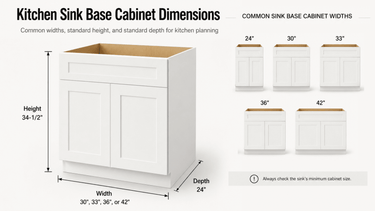
Standard sink base height: Most kitchen sink base
cabinets are 34-1/2 inches high before the countertop is installed.
- Standard sink base depth: Most standard sink base cabinets are 24 inches deep.
- Common sink base widths: 30 inches, 33 inches, and 36 inches are common choices for kitchen layouts.
- Wider sink base options: A 42-inch sink base may be used in larger kitchens or wider sink zones.
- Most important rule: Always check the sink manufacturer’s minimum cabinet size before ordering the cabinet.
For many homeowners, a 30-inch sink base works for compact single-bowl sinks. A 33-inch sink base can fit some larger single-bowl or apron-front sinks, depending on the sink specification.
A 36-inch sink base is one of the most flexible choices for larger single-bowl sinks, many 33-inch sinks, double-bowl sinks, and farmhouse-style layouts.
Do not choose the cabinet only by the sink’s outside width. The sink specification sheet should confirm the minimum cabinet size, mounting style, and any installation requirements.
Kitchen Sink Base Cabinet Size Chart
| Sink Base Width | Common Use | Planning Notes |
|---|---|---|
| 24" | Very small kitchens, bar sinks, compact utility sinks | Limited sink options; not ideal for most full-size kitchen sinks |
| 30" | Compact kitchens, smaller single-bowl sinks | Good for tighter layouts, but sink selection is more limited |
| 33" | Medium kitchens, some larger single-bowl or apron-front sinks | Check the sink’s minimum cabinet requirement carefully |
| 36" | Flexible choice for larger kitchen sinks | Often used for 33" sinks, double-bowl sinks, and many farmhouse layouts |
| 42" | Larger kitchens or wider sink areas | Useful when more sink-zone width is needed, but it takes more cabinet run space |
These are planning ranges, not universal rules. The final cabinet choice depends on the sink design, mounting style, and installation details.
Before choosing a sink base, check:
- Sink bowl width and depth
- Sink rim, clips, and mounting hardware
- Apron-front requirements, if using a farmhouse sink
- Countertop cutout requirements
- Plumbing and disposal clearance
What Is a Sink Base Cabinet?
A sink base cabinet is a base cabinet designed to hold a kitchen sink. Unlike many standard base cabinets, it usually does not have a functional top drawer because the sink bowl and plumbing need space inside the cabinet.
Many sink bases have two doors, a false drawer front, and an open interior. This gives the installer room for the sink bowl, drain line, water supply lines, garbage disposal, and under-sink storage.
Because the sink base is connected to plumbing and countertops, it should be planned earlier than many other cabinets. Once the sink base location is set, the dishwasher, trash cabinet, corner cabinet, and nearby drawer bases usually need to work around it.
Standard Sink Base Cabinet Height
The standard height for many kitchen sink base cabinets is 34-1/2 inches before the countertop is installed. After the countertop is added, the finished working height is usually close to 36 inches.
This is the same standard height used for many regular base cabinets. If you are checking all base cabinet sizes, our standard kitchen cabinet height guide explains how base, wall, and tall cabinet heights work together.
For most DIY kitchen remodels, the sink base height should align with the rest of the base cabinet run. Mixing different base cabinet heights in the same countertop run can create installation problems unless the layout is intentionally designed that way.
Standard Sink Base Cabinet Depth
The standard depth for many kitchen sink base cabinets is 24 inches. This depth allows the sink, plumbing, countertop, and nearby appliances to work with a normal kitchen cabinet run.
The listed cabinet depth is not always the same as the finished countertop depth. Countertops usually extend slightly past the cabinet box.
If you are planning aisle clearance, island spacing, or dishwasher placement, account for the finished countertop edge, not just the cabinet box.
If your layout includes pantry cabinets, refrigerator panels, or different cabinet depths, read our kitchen cabinet depth guide before finalizing the order.
30-Inch Sink Base Cabinets
A 30-inch sink base cabinet is common in smaller kitchens, rental kitchens, apartments, laundry areas, and budget remodels. It can work well with a compact single-bowl sink, especially when the homeowner wants to save space for drawers, a dishwasher, or a corner cabinet nearby.
The limitation is sink selection. A 30-inch sink base often will not work for many 33-inch sinks, wide double-bowl sinks, or larger farmhouse sinks.
If you choose a 30-inch sink base, look for sinks that clearly list a compatible minimum cabinet size. This is a good example of why “almost fits” is not good enough.
The cabinet needs room for the sink bowl, mounting hardware, clips, and sometimes countertop support around the cutout.
33-Inch Sink Base Cabinets
A 33-inch sink base cabinet gives more flexibility than a 30-inch cabinet, but it is still not a universal fit for every 33-inch sink.
Some sinks that are close to 33 inches wide may require a 36-inch base cabinet. Other sinks, especially specific apron-front or self-trimming farmhouse models, may be designed to fit a 33-inch apron sink base.
The only safe way to know is to check the sink specification sheet. If you want a medium-size sink area but do not want to use a full 36-inch cabinet, a 33-inch sink base may be worth considering.
Confirm the sink model before finalizing the cabinet order.
36-Inch Sink Base Cabinets
A 36-inch sink base cabinet is one of the most flexible and common choices for kitchen remodels. It can work with many larger single-bowl sinks, many 33-inch sinks, double-bowl sinks, and some farmhouse sink layouts.
Many DIY homeowners choose a 36-inch sink base because it gives more room for plumbing and installation. It also provides a little more comfort when working around garbage disposals, water filters, under-sink organizers, and cleaning supplies.
After you confirm the sink size, compare available sink base options in the cabinet style you plan to order. On RTA Cabinets House, for example, White Shaker sink base options include 30-inch and 36-inch sink base cabinets, as well as a 36-inch farmhouse sink cabinet.
Always review the exact product dimensions and match them with the sink you plan to use.
Farmhouse Sink Base Cabinet Dimensions
A farmhouse sink base cabinet is designed for an apron-front sink. The front of the sink is exposed, so the cabinet front is different from a standard sink base.
Farmhouse sinks leave less room for guessing because the apron front must work with the cabinet opening. Before choosing a farmhouse sink base, check:
- The sink’s minimum base cabinet size
- The apron height
- The sink width
- The bowl depth
- The cabinet opening
- The countertop cutout requirements
- Whether the sink is undermount, top-mount, flush-mount, or self-trimming
A 36-inch farmhouse sink cabinet is common for many RTA cabinet lines, but some farmhouse sinks may require a different cabinet width. Do not buy the sink and cabinet separately without checking the sink specification sheet.

Choose the Sink Before Finalizing the Cabinet
It is best to choose your sink before the final cabinet list is completed. The sink determines the minimum cabinet width, cutout, plumbing position, and sometimes the countertop fabrication details.
BLANCO’s sink buying guide also recommends choosing the sink early in the planning process. Existing cutouts and cabinet space can limit which sink will work.
You can review their sink buying guide as an outside reference while planning.
For a new kitchen layout, this order usually works better:
- Measure the kitchen.
- Decide the sink location.
- Choose the sink type and size.
- Confirm the sink’s minimum cabinet size.
- Select the correct sink base cabinet.
- Build the rest of the base cabinet run around it.
Sink Base Layout Tips
The sink base cabinet is usually part of the main work zone in the kitchen. It often sits near the dishwasher, trash pull-out, prep area, and sometimes a window.
Before choosing the final sink base width, think about these layout details:
- Dishwasher location: Many kitchens place the dishwasher beside the sink base for easier plumbing and loading.
- Trash storage: If you want a pull-out trash cabinet near the sink, leave room for it in the base run.
- Corner cabinets: Do not crowd the sink base too close to a blind corner or lazy Susan cabinet without checking door swing and filler space.
- Window alignment: If the sink is centered under a window, the cabinet width may need to support that visual centerline.
- Garbage disposal: A disposal takes extra under-sink space and may affect storage accessories.
- Faucet and accessories: Soap dispensers, air switches, filtered water faucets, and side sprayers may affect countertop hole planning.
For broader kitchen planning, the NKBA kitchen planning guidelines are useful for thinking about work aisles, walkways, appliance landing areas, and general kitchen clearance.
Your final cabinet list should still be based on your actual room measurements and product dimensions.

How to Measure for a Sink Base Cabinet
Before ordering a sink base cabinet, prepare a simple kitchen sketch. You can follow our Kitchen Measuring Guide to record the wall lengths, openings, appliances, and obstacles.
For the sink base area, measure and mark:
- Full wall length
- Sink centerline
- Window width and location, if the sink is under a window
- Dishwasher location
- Plumbing rough-in location
- Nearby corner cabinet or filler space needed for door swing or corner clearance
- Distance from the sink area to the range, refrigerator, island, or opposite cabinet run
- Any pipes, outlets, vents, or access panels inside the base area
Photos are helpful, especially if you are requesting a cabinet quote online. Take clear photos of the plumbing, sink wall, window area, dishwasher location, nearby corners, and any tight areas around the sink base.
Common Sink Base Cabinet Mistakes
Most sink base mistakes happen when the sink, cabinet, countertop, and plumbing are planned separately. These are the issues to check before placing the cabinet order.
Choosing the sink after ordering cabinets
This is one of the most common mistakes. The sink’s minimum cabinet size should be confirmed before the cabinet order is finalized.
Once the cabinet is ordered, your sink options may become much more limited.
Assuming a 33-inch sink fits a 33-inch cabinet
Not always. Some 33-inch sinks require a 36-inch cabinet.
Many sinks need extra room for the rim, clips, mounting hardware, and countertop support, so do not guess by sink width alone.
Forgetting about plumbing and disposal space
Under-sink storage is often limited by drain lines, water lines, garbage disposals, and water filters. Do not plan the sink base as if it were a normal storage cabinet.
Ignoring the dishwasher
The dishwasher usually works best near the sink. If the sink base is too wide or placed poorly, loading dishes may feel less convenient, or the door swing may conflict with nearby cabinets.
Not checking farmhouse sink requirements
Farmhouse sinks require more careful planning than standard drop-in or undermount sinks. Always check apron height, cabinet opening, and countertop cutout requirements.
The apron front needs to work with the cabinet opening, not just the sink width.
FAQ: Kitchen Sink Base Cabinet Dimensions
What is the standard size of a kitchen sink base cabinet?
Common kitchen sink base cabinet widths include 30, 33, and 36 inches. The standard height is often 34-1/2 inches, and the standard depth is often 24 inches.
What size sink fits a 30-inch base cabinet?
A 30-inch base cabinet usually works best with a smaller single-bowl sink. Always check the sink manufacturer’s minimum cabinet size before choosing the cabinet.
What size cabinet do I need for a 33-inch sink?
Many 33-inch sinks require a 36-inch base cabinet, but some specific sink models may fit a 33-inch sink base. Check the sink specification sheet instead of guessing by sink width alone.
Is a 36-inch sink base cabinet common?
Yes. A 36-inch sink base is one of the most common and flexible options for kitchen remodels. It can work with many larger single-bowl, double-bowl, and farmhouse sink layouts.
Are sink base cabinets always 24 inches deep?
Most standard kitchen sink base cabinets are 24 inches deep, but specialty cabinets and custom layouts can vary. Confirm the product dimensions before ordering.
Do sink base cabinets have drawers?
Most sink base cabinets do not have a functional top drawer because the sink bowl and plumbing need space. Many have a false drawer front and two doors below.
Can RTA Cabinets House help me choose the right sink base?
Yes. If you are not sure which sink base cabinet fits your layout, submit your measurements, sketch, photos, or blueprint through our Free Kitchen Design Services.
Plan the Sink Base Before the Rest of the Cabinet Run
The sink base cabinet is one of the first cabinets you should confirm in a kitchen layout. Its width affects the sink, countertop cutout, plumbing, dishwasher, trash storage, and surrounding base cabinets.
Start with the sink you want, check its minimum cabinet size, then choose the correct sink base cabinet. After that, build the rest of the base cabinet run around the sink zone.
If you are planning a full kitchen layout, you can also use our 10x10 kitchen cabinet sets as a broad planning reference. For help building the full cabinet list, request a Free Kitchen Cabinet Design & Quote.