


Cabinet depth is the front-to-back measurement of a cabinet box. It tells you how far a cabinet projects from the wall into the room.
For DIY homeowners, this number matters just as much as cabinet height or width. Cabinet depth affects countertop space, storage capacity, appliance alignment, walkway clearance, and how easy the cabinet is to use every day.
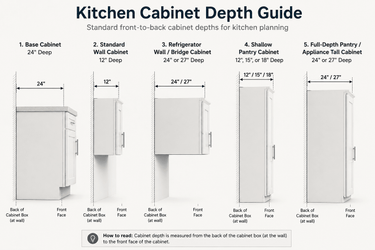
A simple answer is helpful, but kitchen cabinet depth is not the same for every cabinet type. Standard base cabinets are usually 24 inches deep, and standard wall cabinets are often 12 inches deep. Refrigerator wall cabinets, pantry cabinets, tall utility cabinets, shallow storage cabinets, and specialty appliance cabinets may use other depths depending on the cabinet line and layout.
This guide explains the real-world cabinet depths you may see when planning RTA kitchen cabinets, so you can choose the right size before ordering.
Quick Answer: How Deep Are Kitchen Cabinets?
- Base cabinets: Most standard kitchen base cabinets are 24 inches deep.
- Wall cabinets: Most standard wall cabinets are 12 inches deep.
- Refrigerator wall / bridge cabinets: Wall cabinets installed above a refrigerator are often 24 inches deep.
- Tall / pantry / oven cabinets: Tall cabinets, pantry cabinets, oven cabinets, and utility cabinets may be 12, 15, 18, 24, or 27 inches deep, depending on the cabinet type and use.
Cabinet depth usually refers to the cabinet box, not decorative hardware or countertop overhang. Always confirm the exact width, height, and depth on the product page before ordering.
Kitchen Cabinet Depth Chart
| Cabinet Type | Common Depths | Where It Is Used |
|---|---|---|
| Base Cabinets | 24" | Lower cabinet runs, sink bases, drawer bases, countertop support, and appliance areas |
| Standard Wall Cabinets | 12" | Upper storage for dishes, glasses, dry goods, and everyday kitchen items |
| Refrigerator Wall / Bridge Cabinets | 24", sometimes 27" | Above refrigerators, often with refrigerator panels or tall side panels |
| Tall Pantry Cabinets | 12", 15", 18", 24", sometimes 27" | Pantry storage, utility storage, broom storage, and full-height kitchen storage |
| Oven or Appliance Tall Cabinets | 24" or 27" | Wall ovens, microwave cabinets, appliance housing, and deeper built-in layouts |
| Shallow Cabinets | 12", 15", or 18" | Narrow kitchens, side walls, coffee bars, pantry walls, laundry rooms, and compact storage |
| Bathroom Vanity Cabinets | 18" to 21" are common, but varies | Bathroom sink bases and storage vanities |
Vanity cabinet depth is included for comparison, but this guide focuses mainly on kitchen cabinet depth.
If you want a second reference while comparing standard sizes, The Spruce offers a standard kitchen cabinet dimensions guide. Use outside size guides as a planning starting point, but confirm the exact width, height, and depth on the cabinet product page before ordering.
What Does Cabinet Depth Mean?
Cabinet depth means the measurement from the back of the cabinet box to the front face of the cabinet box. In product dimensions, it is usually the last number.
For example, a cabinet listed as 30"W x 34-1/2"H x 24"D is 30 inches wide, 34-1/2 inches high, and 24 inches deep.
Depth usually does not include decorative hardware. For base cabinets, the listed depth is usually the cabinet box, while the finished countertop may be deeper because of overhang.
Depth, height, and width should be checked together before ordering. If you already read our standard kitchen cabinet height guide, cabinet depth is the next measurement to review because it shows how much room the cabinet takes from the wall into the kitchen.
Standard Base Cabinet Depth
The standard depth for most kitchen base cabinets is 24 inches. This is the most common depth for lower cabinets in U.S. kitchens.
A 24-inch deep base cabinet gives enough room for storage, drawers, plumbing, and countertop support. It also helps dishwashers, ranges, and lower cabinet runs line up more cleanly with standard countertop layouts.
Base cabinet depth matters most in these areas:
- Sink base cabinets: Plumbing, sink bowls, and countertop cutouts need enough depth.
- Drawer base cabinets: Drawer box depth and hardware affect usable drawer storage.
- Dishwasher openings: The dishwasher should align with the surrounding base cabinet run.
- Range areas: Nearby cabinets and countertops should line up cleanly with the appliance.
- Kitchen islands: Cabinet depth affects seating overhang, walkway clearance, and storage direction.
Some specialty base cabinets may be shallower or deeper, but 24 inches is the standard starting point for most full kitchen layouts.
Standard Wall Cabinet Depth
Most standard wall cabinets are 12 inches deep. These are the upper cabinets installed above countertops and work areas.
There is a practical reason upper cabinets are shallower than base cabinets. If a wall cabinet were 24 inches deep over a standard countertop, it could make the counter feel crowded and make items at the back harder to reach.
A 12-inch deep wall cabinet is usually easier for daily use. It works well for dishes, glasses, mugs, spices, dry goods, and lighter kitchen items.
Some product lines include 15, 18, 24, or even 27-inch deep wall cabinets for special applications. These are usually not used for a normal upper cabinet run above a standard countertop.
Why Some Wall Cabinets Are 24 Inches Deep
The most common example is the refrigerator wall cabinet. This cabinet is installed above the refrigerator and is often called an over-fridge cabinet, refrigerator bridge cabinet, or bridge wall cabinet.
Unlike standard upper cabinets, refrigerator wall cabinets are often 24 inches deep. The deeper box helps the cabinet align with the refrigerator area, especially when the design includes refrigerator end panels or a full-height pantry cabinet beside the fridge.
This is why you should not assume every wall cabinet on your order is 12 inches deep. Most everyday wall cabinets are 12 inches deep, but refrigerator wall cabinets are commonly deeper.
Deep wall cabinets also need more careful installation. Because these cabinets are deeper and heavier than standard wall cabinets, check the installation instructions and surrounding panels carefully before ordering or installing them.
Standard Pantry and Tall Cabinet Depth
Tall cabinets and pantry cabinets have the widest range of common depths. Depending on the cabinet line and purpose, you may see 12-inch, 15-inch, 18-inch, 24-inch, or 27-inch deep tall cabinets.
| Tall / Pantry Cabinet Depth | Best Used For | Planning Note |
|---|---|---|
| 12" | Shallow food storage, side walls, hallway storage, smaller homes | Easy to see and reach smaller items |
| 15" or 18" | Pantry storage where walkway space still matters | More storage than 12" without projecting as far as 24" |
| 24" | Full-depth pantry storage and end-of-run tall cabinets | Usually aligns with standard base cabinets |
| 27" | Appliance housing, oven cabinets, deeper pantry storage, or refrigerator-side layouts | Use where deeper cabinetry is intended in the layout |
A shallow pantry can make smaller items easier to see and reach. A deeper pantry can hold more, but it should be planned carefully so items do not get lost in the back.
12-Inch vs 24-Inch Pantry Cabinet Depth
Start with what you plan to store, then check how much walkway space you can give up.
Choose a 12-inch pantry cabinet if you want shallow, easy-to-see storage. This works well for canned goods, spices, snacks, baking supplies, and smaller pantry items.
Choose a 24-inch pantry cabinet if you need more storage volume, want the pantry to align with base cabinets, or plan to store larger items such as small appliances, bulk goods, cookware, or deep bins.
The tradeoff is accessibility. A deep pantry stores more, but items can get lost in the back unless the shelves are organized carefully or used with roll-out trays, pull-outs, or baskets where available.
When 15-Inch or 18-Inch Deep Cabinets Make Sense
In some layouts, a shallower cabinet is the better choice. A 15-inch or 18-inch deep cabinet can add storage without taking as much floor space as a full-depth cabinet.
Consider a 15-inch or 18-inch deep cabinet when:
- Your kitchen is narrow or galley-style.
- You want extra storage on a side wall without blocking traffic.
- You are planning a coffee bar, pantry wall, mudroom, or laundry area.
- You want food items to stay visible instead of disappearing in deep shelves.
- You need storage near a doorway, window, radiator, or walkway.
For DIY homeowners, cabinet depth is more than a number on the product page. The deepest cabinet is not always the best cabinet for the way the room will be used.
How Cabinet Depth Affects Layout and Clearance
Cabinet depth affects how the kitchen feels in real life. A deeper cabinet may add storage, but it also takes space away from walkways, appliance doors, seating areas, and working aisles.
Before choosing deeper cabinets, check the space around:
- Refrigerator doors and handles
- Dishwasher door swing
- Range and oven door clearance
- Island walkways
- Corner cabinet access
- Pantry doors and pull-outs
- Walkways between cabinet runs
The National Kitchen & Bath Association provides broader NKBA kitchen planning guidelines that discuss work aisles, walkways, appliance landing areas, and clearances. These guidelines can help you think through movement in the kitchen, but your final cabinet order should still be based on your room measurements and exact product dimensions.
Depth also affects how finished a kitchen looks. A 24-inch deep refrigerator wall cabinet with side panels can help a refrigerator look more built in, while a shallow pantry can make a tight wall more useful without making the room feel crowded.
How to Measure Cabinet Depth Before Ordering
Before ordering cabinets, measure your kitchen in inches and sketch the layout. You can use our Kitchen Measuring Guide to prepare your wall measurements, appliance locations, windows, doors, and obstacles.
For cabinet depth planning, measure:
- Wall-to-wall dimensions
- Ceiling height
- Walkway width between cabinet runs, islands, appliances, and walls
- Distance between opposite cabinet runs
- Refrigerator, range, dishwasher, and sink locations
- Door and window openings
- Vents, pipes, outlets, switches, soffits, and access panels
- How far current appliances project from the wall
Photos are also helpful. Take clear photos of refrigerator walls, corners, windows, soffits, vents, and any tight walkway or appliance area that may affect cabinet depth.
Common Mistakes When Choosing Cabinet Depth
Most depth mistakes happen when homeowners check the cabinet box but forget the finished layout. Countertop overhang, appliance handles, door swing, and walkway clearance can all change how the cabinet depth feels after installation.
Assuming all wall cabinets are 12 inches deep
Most standard wall cabinets are 12 inches deep, but refrigerator wall cabinets and specialty wall cabinets can be 24 inches deep or deeper. This matters most above refrigerators, where a shallow cabinet may not align well with the appliance area.
Forgetting countertop overhang
Base cabinet depth and finished countertop depth are not always the same. Countertops usually extend slightly past the cabinet box, which can affect walkways, island clearance, and appliance door clearance.
Choosing a deep pantry without planning shelf access
A deep pantry can hold more, but it can also hide items in the back. Plan how you will reach items on deep shelves, especially if you are not using pull-outs, baskets, or other organizers.
Ignoring refrigerator depth
Refrigerators vary widely. Measure the refrigerator body, handles, and door swing, not just the opening width.
Ordering before checking the exact product page
Cabinet depth can vary by product line, cabinet type, and manufacturer. Check the product page for that exact SKU before adding it to the cabinet list.
FAQ: Kitchen Cabinet Depth
How deep are standard kitchen base cabinets?
Most standard kitchen base cabinets are 24 inches deep. This depth supports countertops, sink bases, drawer bases, and common appliance layouts.
How deep are standard wall cabinets?
Most standard wall cabinets are 12 inches deep. This depth is common for regular upper cabinet runs above countertops.
Are wall cabinets ever 24 inches deep?
Yes. Wall cabinets above refrigerators are often 24 inches deep, but they are not usually used for regular upper cabinet runs. These are commonly called refrigerator wall cabinets, over-fridge cabinets, or bridge cabinets.
How deep are pantry cabinets?
Pantry cabinets can be 12, 15, 18, 24, or sometimes 27 inches deep. The right depth depends on the cabinet line, storage purpose, and available walkway space.
What is the best pantry depth?
There is no single best pantry depth. A 12-inch pantry works well for visible small items, a 24-inch pantry works better for larger storage, and a 15-inch or 18-inch pantry can be a useful middle ground.
Does cabinet depth include doors?
Product listings may vary. Check whether the listed depth refers to the cabinet box, the assembled cabinet, or includes the door or front.
Does cabinet depth include countertop overhang?
No. Base cabinet depth usually does not include countertop overhang. The finished countertop may extend slightly beyond the cabinet box.
Can RTA Cabinets House help me choose the right cabinet depth?
Yes. If you are not sure which depth works for your kitchen, submit your measurements, photos, or sketch through our Free Kitchen Cabinet Design page. Our team can help prepare a cabinet list for your layout.
Start With the Standard Depth, Then Check the Real Layout
Standard cabinet depths are a useful starting point: 24 inches for many base cabinets, 12 inches for many everyday wall cabinets, and 12 to 24 inches for many pantry cabinets. But real kitchens often need more detail. Refrigerator wall cabinets can be 24 inches deep. Tall pantry cabinets may come in shallow, standard, or extra-deep options. Appliance cabinets may need 24 or 27 inches of depth.
If you are still planning the full layout, review our 10x10 kitchen cabinet sets as a starting point, or request a Free Kitchen Cabinet Design & Quote.