


Corner kitchen cabinets are some of the most confusing cabinets in a DIY kitchen layout. A regular base cabinet is easy to understand by width, height, and depth. A corner cabinet is different because it has to deal with the hard-to-reach space where two cabinet runs meet at a 90-degree corner.
If you are ordering RTA kitchen cabinets online, choosing the wrong corner cabinet can affect both walls of the kitchen. It may change the sink run, dishwasher location, drawer cabinet placement, door swing, fillers, and countertop layout.
This guide explains common corner kitchen cabinet dimensions, including lazy Susan corner base cabinets, blind corner base cabinets, corner wall cabinets, and layout details to check before ordering.
Quick Answer: Common Corner Cabinet Dimensions
- Lazy Susan corner base cabinets: Common sizes include 33 inches and 36 inches wide.
- Base corner height and depth: Many corner base cabinets are 34-1/2 inches high and 24 inches deep, matching standard base cabinet height and depth.
- Blind corner base cabinets: Sizes vary more. You may see 33-inch, 36-inch, 39-inch, 42-inch, or larger options depending on the cabinet line.
- Corner wall cabinets: Many are about 12 inches deep, but width and height depend on the cabinet style and upper cabinet layout.
- Key rule: Do not choose a corner cabinet by width alone. Check the full layout, adjacent cabinets, fillers, door swing, and installation notes.
Blind corner cabinets often need more planning than the listed width suggests. Some require a pull distance from the corner, filler space, or a minimum opening so the door and organizer can work properly.
Corner Cabinet Size Chart
| Corner Cabinet Type | Common Size Range | Typical Use |
|---|---|---|
| Lazy Susan Corner Base Cabinet | 33" or 36" wide; often 34-1/2" high x 24" deep | Base corner storage with rotating shelves or turntables |
| Blind Corner Base Cabinet | 33", 36", 39", 42" or larger; often 34-1/2" high x 24" deep | Base corner storage where part of the cabinet extends into a hidden corner |
| Diagonal Corner Wall Cabinet | Commonly 24" wide or larger; usually 12" deep; height varies | Upper corner storage with a diagonal front |
| Blind Corner Wall Cabinet | Varies by cabinet line; often 12" deep | Upper corner storage when two wall cabinet runs meet |
| Corner Filler | Usually 3" or wider; varies by layout | Creates space so doors, drawers, and handles can open properly |
Use this chart to identify the cabinet type first. Then check the product page for the exact size, filler needs, door configuration, and installation notes before finalizing your cabinet list.

What Is a Corner Kitchen Cabinet?
A corner kitchen cabinet is a cabinet designed for the 90-degree corner where two cabinet runs meet. Without a corner cabinet or corner planning strategy, this area can become hard to reach or completely wasted.
There are two main goals when planning a corner cabinet:
- Use the corner storage space effectively.
- Keep nearby cabinet doors, drawers, appliances, and walkways functional.
This is why corner cabinets are not only a storage decision. They affect the cabinet widths on both walls and can change the position of the sink base, dishwasher, range, drawer bases, and fillers around the corner.
Lazy Susan Corner Base Cabinet Dimensions
A lazy Susan corner base cabinet is a corner base cabinet with rotating shelves inside. It is one of the most common corner cabinet choices for DIY kitchen remodels because it makes the corner easier to access.
Common lazy Susan corner base cabinet widths include 33 inches and 36 inches. Many RTA cabinet lines use a standard base cabinet height of 34-1/2 inches and a standard depth of 24 inches.
That means the corner cabinet takes more planning space than a simple straight base cabinet. After you know which size your layout can support, compare the available lazy Susan options in your cabinet line.
For example, RTA Cabinets House offers lazy Susan corner base cabinets in 33-inch and 36-inch widths in select cabinet lines. These are designed for lower corner storage and can help homeowners reach items that would otherwise sit deep in the corner.
When a Lazy Susan Corner Base Works Well
A lazy Susan corner base can work well when:
- You want easier access to the corner.
- You store pots, pans, mixing bowls, small appliances, or pantry items in the base corner.
- You prefer a rotating shelf instead of reaching into a deep blind area.
- Your layout has enough space for a 33-inch or 36-inch corner cabinet.
- The nearby cabinets still have room to open properly.
The main benefit is access. Instead of reaching deep into the corner, the rotating shelf brings items closer to the front of the cabinet.
Lazy Susan Planning Notes
Before choosing a lazy Susan base, check the door style and shelf configuration. Some lazy Susan cabinets use a bifold door, while others use doors or shelves that move differently.
The cabinet may look similar from the front, but the way it opens and stores items can feel different in daily use. This matters if you plan to store larger bowls, cookware, or small appliances in the corner.
You should also check what cabinets will sit on both sides of the corner. Nearby drawer bases, dishwashers, ranges, and sink bases may need fillers or spacing so doors and handles do not collide.
Blind Corner Base Cabinet Dimensions
A blind corner base cabinet is another common way to handle a kitchen corner. Part of the cabinet extends into the corner and becomes hidden, or “blind.”
The door is usually on one side, while the deeper storage area sits behind the adjacent cabinet run. This can keep the cabinet run looking more continuous, but the back of the cabinet is harder to reach.
Blind corner base cabinet dimensions vary more than lazy Susan cabinet dimensions. You may see 33-inch, 36-inch, 39-inch, 42-inch, or larger blind corner base cabinets depending on the cabinet manufacturer and how the cabinet is meant to be installed.
The listed cabinet width is not the only number that matters. Many blind corner cabinets need to be pulled a certain distance from the corner or paired with a filler so the door and any pull-out organizer can open correctly.
When a Blind Corner Base Works Well
A blind corner base may work well when:
- You want a more continuous cabinet run instead of a diagonal corner look.
- The layout does not have enough room for a larger lazy Susan corner cabinet.
- You plan to use a blind corner pull-out organizer.
- You want flexibility in how the cabinet run turns the corner.
The tradeoff is access. A blind corner cabinet can provide a lot of storage, but items in the back are harder to reach unless you use a pull-out system, rotating shelf, or other corner organizer.
Corner Wall Cabinet Dimensions
Corner wall cabinets are upper cabinets used where two wall cabinet runs meet. Like regular wall cabinets, they are usually shallower than base cabinets.
Many standard wall cabinets are about 12 inches deep, but corner wall cabinet widths and heights vary by cabinet line. You may see diagonal corner wall cabinets, blind corner wall cabinets, or regular wall cabinets arranged with fillers to meet at the corner.
Corner wall cabinets need to line up with the rest of the upper cabinet run, not just fill the corner. Ceiling height, upper cabinet height, crown molding, appliance clearance, and door swing can all affect the final choice.
If you are still confirming upper cabinet height or depth, read our standard kitchen cabinet height guide and kitchen cabinet depth guide before choosing the corner wall cabinet.
Lazy Susan vs Blind Corner Cabinet
The best corner cabinet depends on the layout, storage needs, and how much access you want inside the corner.
| Option | Best For | Watch Out For |
|---|---|---|
| Lazy Susan Corner Base | Easy access, rotating storage, common DIY layouts | Needs enough corner space; nearby doors and handles still need clearance |
| Blind Corner Base | Continuous cabinet runs, flexible layouts, pull-out organizers | Hidden storage can be hard to reach without an organizer |
| Corner Wall Cabinet | Upper corner storage and matching wall cabinet runs | Needs to align with upper cabinet height and door swing |
| Corner Filler Only | Simple layouts where storage is less important | Storage may be sacrificed to keep the layout functional |
If you are comparing storage accessories, outside examples can help you visualize the options. The Spruce provides a useful overview of corner cabinet storage solutions, including lazy Susans, half-moon shelves, pull-outs, and other blind corner options.
How Corner Cabinets Affect Kitchen Layout
A corner cabinet changes both walls in the kitchen. You cannot plan one wall first, then casually add a corner cabinet later.
The corner should be considered early because it affects the cabinet sequence on both sides.
Before choosing a corner cabinet, think about:
- Which cabinet run starts at the corner
- Whether the sink base is near the corner
- Whether the dishwasher is near the corner
- Whether drawers or pull-outs will open into the corner area
- Whether a range or refrigerator is close to the corner
- Whether fillers are needed for door and hardware clearance
- How the countertop will turn the corner

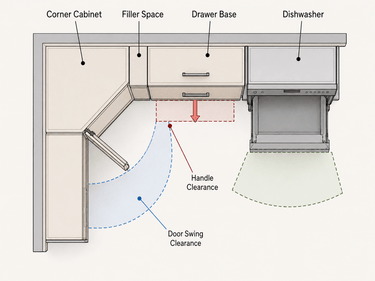
For example, if the dishwasher is too close to a corner cabinet, the dishwasher door may block access to nearby storage. If a drawer base is too close to the corner without proper filler, handles may collide. If a sink base is placed too tightly against the corner, the work area may feel cramped.
For broader clearance planning around work zones, the NKBA kitchen planning guidelines are helpful for thinking about work aisles, walkways, appliance landing areas, and general clearance around kitchen work zones.
What to Measure Before Ordering a Corner Cabinet
Before ordering a corner cabinet, create a simple kitchen sketch. You can use our Kitchen Measuring Guide to record wall lengths, openings, appliances, and obstacles.
For a corner cabinet, measure and mark:
- Both wall lengths that meet at the corner
- The exact corner angle, especially if the walls are not perfectly square
- Window and door openings near the corner
- Sink, dishwasher, range, and refrigerator locations
- Any pipes, vents, outlets, switches, or access panels
- Walkway and island clearance near the corner
- Whether filler space is needed so nearby doors, drawers, and handles can open
- Which way nearby doors and drawers will open
Photos are especially helpful for corners. Take photos from both cabinet runs, not just straight into the corner. A photo can show trim, baseboards, wall irregularities, outlets, vents, or plumbing conditions that may not appear in a sketch.
Common Corner Cabinet Mistakes
Most corner cabinet mistakes happen when homeowners choose the cabinet by size but forget clearance, filler, and door swing. Check these issues before you finalize the cabinet list.
Choosing the corner cabinet too late
The corner cabinet should be planned early. It controls how two cabinet runs meet and can affect the size of nearby cabinets.
If the corner changes later, the cabinet sizes on both walls may need to be adjusted.
Ignoring fillers
Fillers are small spacer pieces that create room for doors, drawers, and handles to clear each other. Skipping fillers can create collisions in the corner.
Assuming all blind corner cabinets install the same way
Blind corner cabinets vary by cabinet line. Some need to be pulled a certain distance from the corner or installed with a specific filler.
Always check the product specifications before adding a blind corner cabinet to the layout.
Putting drawers too close to the corner
Drawer fronts and handles need room to open without hitting the adjacent cabinet run or appliance handle. Even if the drawer box fits on paper, the handle may not clear the next cabinet.
Forgetting the countertop
Corner cabinets also affect countertop seams, overhang, and support. The cabinet layout should make sense before countertop fabrication.
Not checking left-hand or right-hand configuration
Some blind corner and corner wall cabinets may be left-hand, right-hand, or reversible. The wrong handing can put the opening on the wrong side of the corner.
Confirm the configuration before ordering.
FAQ: Corner Kitchen Cabinet Dimensions
What is the standard size of a lazy Susan corner base cabinet?
Common lazy Susan corner base cabinet widths include 33 inches and 36 inches. Many are 34-1/2 inches high and 24 inches deep, but exact dimensions vary by cabinet line.
What is the standard size of a blind corner base cabinet?
Blind corner base cabinets vary more than lazy Susan cabinets. Common market sizes include 33, 36, 39, 42 inches, and larger options.
Check the product page for the required pull from the corner, filler space, and installation notes.
Is a lazy Susan better than a blind corner cabinet?
A lazy Susan is usually easier to access, while a blind corner cabinet can work better for certain layouts and continuous cabinet runs. The best choice depends on space, storage needs, and nearby cabinet placement.
How deep are corner base cabinets?
Many corner base cabinets are 24 inches deep, matching standard base cabinet depth. Specialty corner cabinets may vary, so check the product page before ordering.
Do corner cabinets need fillers?
Often, yes. Fillers create space so doors, drawers, and hardware can clear the adjacent cabinet run.
The exact filler need depends on cabinet style, overlay, handle size, and layout.
Can I put a sink next to a corner cabinet?
Yes, but it needs careful planning. Check sink base width, dishwasher location, door swing, countertop space, and filler requirements before finalizing the layout.
You can also read our sink base cabinet dimension guide for more planning details.
Can RTA Cabinets House help me choose the right corner cabinet?
Yes. If you are not sure whether your layout needs a lazy Susan corner base, blind corner base, filler, or another solution, submit your measurements, sketch, photos, or blueprint through our Free Kitchen Design Services.
Plan the Corner Before You Build the Full Cabinet List
Corner cabinets may look like small layout details, but they affect both cabinet runs. A 33-inch or 36-inch lazy Susan corner base may be the right solution for some DIY kitchens, while a blind corner base may work better for others.
Corner wall cabinets, fillers, adjacent drawer bases, dishwasher placement, and countertop turns should be checked together. This helps avoid door collisions, awkward appliance placement, and wasted corner storage.
Before ordering, measure both walls, mark nearby appliances, check door and drawer clearance, and confirm the exact cabinet specifications. You can explore our base cabinets to compare available corner base cabinet options.
If you are still choosing a cabinet style after the layout is clear, you can compare options such as White Shaker RTA cabinets. For a broader planning reference, our 10x10 kitchen cabinet sets can help you understand how a basic cabinet package is structured.
If you want help building the full cabinet list, request a Free Kitchen Cabinet Design & Quote before placing your order.