


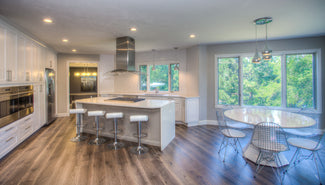
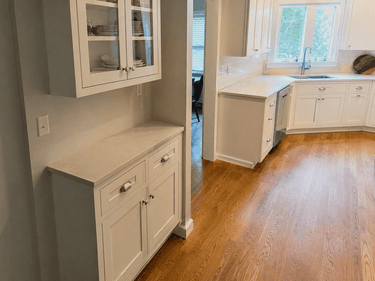
18 inch deep base kitchen cabinets are shallow-depth lower cabinets designed for tight or unusual spaces. They can be useful in narrow kitchens, side walls, pantry zones, laundry rooms, coffee bars, or areas where a standard cabinet would make the walkway too tight.
For most full kitchen cabinet runs, though, a standard 24 inch deep base cabinet is still the better starting point. A 24 inch depth usually gives more usable storage, stronger countertop support, easier sink and appliance planning, and a more typical kitchen layout.
This guide explains when 18 inch deep base cabinets make sense, when they create limits, and why many DIY homeowners ordering RTA kitchen cabinets online should still start with standard 24 inch deep base cabinets.
Quick Answer: Are 18 Inch Deep Base Cabinets Standard?
No. 18 inch deep base cabinets are not the standard depth for most kitchen base cabinets. The standard depth for most kitchen base cabinets is 24 inches.
18 inch deep base cabinets do exist. They are often used as shallow-depth, reduced-depth, or semi-custom cabinet solutions, but they are not the default choice for a normal sink run, range run, dishwasher run, or main countertop area.
At this time, RTA Cabinets House focuses on standard 24 inch deep kitchen base cabinets. These are a better match for most full kitchen layouts because they work more easily with countertops, sinks, drawers, dishwashers, ranges, and everyday storage.

18 Inch vs 24 Inch Deep Base Cabinet Chart
| Cabinet Depth | Best For | Limitations |
|---|---|---|
| 18" Deep Base Cabinet | Narrow kitchens, side walls, shallow storage, coffee bars, laundry rooms, pantry walls, tight walkways | Less storage, limited sink use, shorter drawers, special countertop planning, fewer stock options |
| 24" Deep Base Cabinet | Main kitchen runs, sink bases, drawer bases, appliance areas, standard countertops, islands, everyday storage | Takes more floor space and may feel too deep in very narrow layouts |
A shallow cabinet can solve a space problem, but it also creates new planning limits. Before choosing an 18 inch cabinet, decide whether the layout truly needs a cabinet that sticks out less from the wall, or whether a standard 24 inch deep base cabinet will work better.
What Is an 18 Inch Deep Base Cabinet?
An 18 inch deep base cabinet is a lower cabinet that projects about 18 inches from the wall instead of the more common 24 inches. It still usually sits on the floor like a standard base cabinet, but it has less front-to-back storage space.
In product dimensions, depth is usually the last number. For example:
18"W x 34-1/2"H x 24"D means the cabinet is 18 inches wide, 34-1/2 inches high, and 24 inches deep.
24"W x 34-1/2"H x 18"D would mean the cabinet is 24 inches wide, 34-1/2 inches high, and 18 inches deep.
This distinction matters because many homeowners confuse 18 inch wide cabinets with 18 inch deep cabinets. A cabinet can be 18 inches wide and still be the standard 24 inches deep, so check the “D” measurement before ordering.
When 18 Inch Deep Base Cabinets Make Sense
18 inch deep base cabinets can be useful when saving walkway space matters more than getting the most storage. They work best in secondary areas, not in the main sink, range, or dishwasher run.
1. Narrow Galley Kitchens
In a narrow galley kitchen, two full-depth cabinet runs may leave the walkway too tight. A shallow cabinet run on one side can help preserve walking space while still adding storage.
This is especially useful when one side of the kitchen is used for lighter storage, pantry items, or a small prep zone. If that same side includes a sink, dishwasher, or range, a standard 24 inch deep base cabinet is usually easier to plan.
2. Coffee Bars and Beverage Stations
A coffee bar does not always need a full 24 inch deep base cabinet. If the area is mainly used for a coffee maker, mugs, syrups, small appliances, or dry storage, a shallow cabinet can sometimes feel more proportional.
A shallow cabinet may be enough if the area is not used for major prep, sink work, or large cookware storage.

3. Pantry Walls
Shallow cabinets can work well for pantry storage because they make items easier to see. Deep shelves can hide cans, jars, and small packages in the back.
A shallow pantry wall can keep everyday dry goods more visible. It is usually less useful for heavy cookware, deep bins, or larger countertop appliances.
4. Laundry Rooms and Utility Areas
In a laundry room, mudroom, or utility area, shallow base cabinets can add storage without crowding the walkway. This is especially helpful around doors, machines, or narrow passages.
This is different from a main kitchen work run. Laundry and utility areas often need storage, but they may not need the same sink, appliance, and countertop support as a primary kitchen cabinet run.
5. Tight Side Walls or Transition Areas
If you have a short wall near a doorway, dining area, or hallway opening, a shallow cabinet can create a useful drop zone without making the room feel blocked.
This type of cabinet can work well for small storage, mail, keys, pantry overflow, or light household items.
When 24 Inch Deep Base Cabinets Are the Better Choice
For most full kitchen layouts, 24 inch deep base cabinets are the more reliable starting point. They are more compatible with standard countertops, sinks, appliances, drawers, and storage accessories.
You should usually choose 24 inch deep base cabinets for:
- Main lower cabinet runs
- Sink base cabinets
- Dishwasher areas
- Range and cooktop areas
- Drawer base cabinets
- Trash pull-out cabinets
- Kitchen islands
- Standard countertop layouts
If you are building a normal kitchen work zone, shallow cabinets can create layout problems. The countertop may feel too narrow, the drawers may lose usable storage, and appliances may not align properly with the cabinet run.
Because of these planning needs, RTA Cabinets House focuses on standard 24 inch deep kitchen base cabinets for most RTA cabinet layouts. For many DIY homeowners, standard-depth base cabinets are easier to match with the rest of the kitchen.

Why Standard Kitchen Base Cabinets Are Usually 24 Inches Deep
Kitchen base cabinets are typically 24 inches deep because this depth balances storage, reach, and countertop support.
A standard 24 inch deep base cabinet can support a countertop with a slight overhang, creating a finished counter depth that is slightly deeper than the cabinet box. This works well for food prep, sink use, small appliances, and everyday kitchen tasks.
It also gives enough room for:
- Full-depth drawers
- Sink plumbing
- Garbage disposals
- Trash pull-out systems
- Cookware storage
- Countertop appliances
- Dishwasher alignment
If you want a second reference for standard cabinet sizing, The Spruce provides a standard kitchen cabinet dimensions guide that explains common base cabinet height, depth, and width ranges. Use outside references as a planning starting point, then confirm the exact product dimensions before ordering.
What You Lose With an 18 Inch Deep Base Cabinet
An 18 inch deep base cabinet saves floor space, but it also gives up storage and flexibility. What you gain in walkway space, you may lose in drawer depth, countertop function, and appliance compatibility.
Less Drawer Space
Reduced-depth drawer bases have shorter drawers. This can make it harder to store pots, pans, baking sheets, mixing bowls, larger utensils, and kitchen tools the way homeowners expect.
Less Countertop Depth
If the cabinet run uses a reduced-depth countertop, the work surface may feel too shallow for food prep. If you use a standard-depth countertop over a shallow cabinet, the installer may need to plan extra support under the countertop.
Limited Sink Compatibility
Most kitchen sinks are not designed around shallow base cabinets. The issue is not just sink width; sink bowl depth, plumbing, disposal space, and countertop support also matter.
If you are planning a sink area, read our sink base cabinet dimensions guide before choosing the cabinet depth.
More Layout Coordination
Shallow cabinets can create depth changes in the kitchen. One section of cabinets may sit back from the rest of the run, which can affect the countertop, panels, fillers, and trim.
Sometimes this looks intentional and helpful. Other times, it can make the cabinet run feel uneven unless the details are planned carefully.
Better Alternatives to 18 Inch Deep Base Cabinets
If you are considering 18 inch deep base cabinets because the kitchen feels tight, you may have other options. In many layouts, the better fix is not reducing every base cabinet depth.
Use Standard 24 Inch Base Cabinets Only Where They Matter
You may not need shallow cabinets everywhere. In many layouts, you can keep standard 24 inch deep base cabinets at the sink, range, main prep zone, or dishwasher area, then solve the tight area separately.
This keeps the main kitchen work zone easier to plan while still giving you flexibility in secondary areas.
Use Wall Cabinets or Tall Pantry Cabinets for Shallow Storage
If you need shallow storage, consider whether a wall cabinet, pantry cabinet, or utility cabinet would work better than a shallow base cabinet. Shallow wall or pantry storage can keep items visible without changing the main countertop depth.
Use Narrow Width, Standard Depth Cabinets
Sometimes the problem is not depth. It may be width. A 12 inch, 15 inch, or 18 inch wide base cabinet with standard 24 inch depth can add useful storage without reducing the entire countertop depth.
For example, RTA Cabinets House offers standard-depth base cabinets in multiple widths, including narrow options such as 12, 15, and 18 inches wide. These can help fill a cabinet run while keeping the standard 24 inch depth.
Adjust the Layout Before Reducing Cabinet Depth
Before switching to shallow base cabinets, check whether you can solve the issue by adjusting the layout:
- Move the island
- Reduce the island size
- Change the corner cabinet
- Adjust appliance placement
- Use a different base cabinet width
- Add filler or open space where needed
If the tight area is caused by a corner layout, review our corner kitchen cabinet dimensions guide before finalizing the cabinet run.
How to Measure Before Choosing Cabinet Depth
Cabinet depth should be based on the real room, not only on what sounds space-saving. Before choosing 18 inch or 24 inch depth, measure your kitchen carefully.
Use our Kitchen Measuring Guide to prepare your sketch. For cabinet depth planning, measure:
- Full wall lengths
- Walkway width
- Distance between opposite cabinet runs
- Island clearance
- Door and window openings
- Dishwasher, range, refrigerator, and sink locations
- How far existing appliances project from the wall
- Any vents, pipes, outlets, switches, radiators, or access panels
For broader kitchen planning, the NKBA kitchen planning guidelines are useful for thinking about walkways, work aisles, appliance landing areas, and clearance.
Your final cabinet list should still be based on your exact room measurements and product dimensions.
FAQ: 18 Inch Deep Base Kitchen Cabinets
Are 18 inch deep base cabinets standard?
No. Standard kitchen base cabinets are usually 24 inches deep. 18 inch deep base cabinets are shallow-depth options used for special layouts, tight spaces, and reduced-depth storage.
Do 18 inch deep base cabinets exist?
Yes. Some manufacturers and semi-custom cabinet lines offer 18 inch deep base cabinets. However, they are not as common as standard 24 inch deep kitchen base cabinets.
Does RTA Cabinets House sell 18 inch deep base cabinets?
At this time, RTA Cabinets House focuses on standard 24 inch deep kitchen base cabinets. These better match most countertop, sink, drawer, appliance, and everyday storage needs in full kitchen layouts.
When should I use an 18 inch deep base cabinet?
Use an 18 inch deep base cabinet only when the layout truly needs reduced depth, such as a narrow galley kitchen, side wall, pantry zone, laundry room, coffee bar, or tight transition area.
Can I use an 18 inch deep cabinet for a kitchen sink?
Usually, a standard 24 inch deep sink base is a better choice. Most kitchen sinks, plumbing, and countertop layouts are designed around standard-depth base cabinets.
The issue is not just sink width; plumbing, bowl depth, disposal space, and countertop support also matter.
Is 24 inches too deep for a small kitchen?
Not always. A 24 inch deep base cabinet is still the standard for most kitchen work zones.
If the kitchen feels tight, first check the overall layout, appliance placement, island clearance, and cabinet widths before switching to shallow base cabinets.
What should I buy if I was searching for 18 inch deep base cabinets?
If you are planning a standard kitchen cabinet run, compare 24 inch deep base cabinets first. If the area is truly shallow, request layout help before ordering so you can avoid choosing a cabinet depth that creates countertop, sink, or appliance problems.
Start With 24 Inch Deep Base Cabinets for Most Kitchen Layouts
18 inch deep base kitchen cabinets can be useful in special spaces, but they are not the standard choice for most kitchens. If you are planning a main cabinet run, sink area, drawer storage, dishwasher opening, range zone, or kitchen island, standard 24 inch deep base cabinets usually make sink planning, appliance alignment, drawer storage, and countertop support easier.
If you are not sure whether your space needs a standard-depth or shallow-depth solution, request a Free Kitchen Cabinet Design & Quote.