


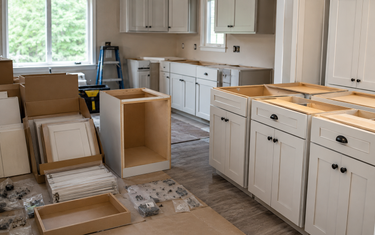
Selecting new cabinets seems like it should be an easy task until you hit upon one of the most frequent remodel dilemmas: RTA vs. assembled cabinets.
If you are considering your estimates at this very moment, you likely are looking not only at the issue of cabinet boxes. Your question is more related to your willingness to do some extra work, potential risks associated with shipping and installing cabinets, and whether your initial savings from RTA cabinets can compensate for their higher expenses in the long run.
The brief answer to your question looks something like this: both options are equal, but they depend on your budget, deadlines, cabinet design complexity, and ability to handle assembly and installation yourself. Many people find that good RTA cabinets provide them with significant savings without compromising the quality of the final product. Other homeowners would rather spend more on their cabinets, as the extra money pays for faster installation and eliminates one extra element from their remodeling schedule.
What are RTA cabinets?
RTA stands for ready-to-assemble. They arrive flat-packed in boxes, and assembly takes place after arrival.
This reduced shipping volume is a reason why a lot of people go with RTA from the start. When talking about remodels currently in progress, it becomes clear through homeowner and contractor comments that RTA is considered the low-cost choice initially, particularly when the buyer is prepared to assemble the RTA themselves or pay less for the local assembly fee. Nevertheless, it's important to point out that at the same time, people note that RTA will be worth the investment if its construction materials and hardware are of high quality and the cabinets themselves have been properly assembled.
RTA cabinets can be a good choice if...
- You're interested in controlling your expenses.
- You don't mind getting your hands dirty.
- You have enough free time to assemble your new cabinets.
- You prefer cabinets delivered in a form that's easy to maneuver through narrow spaces.
What are assembled cabinets?
Assembled cabinets come pre-assembled. More often than not, this usually means less work for you and a shorter route to installing them.
In some renovations, it definitely makes sense to shell out the extra money. Some homeowners who participated in recent debates mentioned that they opted for assembled cabinets because they had more money than time, they were eager to get started, or they just did not feel like spending several days assembling cabinet boxes before the actual installation process could begin.
Assembled cabinets may be more appropriate when...
- You have a tight renovation schedule.
- You are contracting someone to install them.
- You do not want to worry about the quality of the assembly process.
- You prefer a simpler project, albeit at a higher initial cost.
The bottom line is not just about pricing
Many consumers begin their search with a simple price comparison between cabinets. While this is logical, it is also the trap that catches many people out.
Ready-to-assemble cabinets are often cheaper than their counterparts in terms of unit price. On the other hand, assembled cabinets often carry a higher price tag since they come with factory assembly and increased transportation and handling costs. But the point here is the overall cost of the project.
Consider these questions to see the difference:
- Will you assemble the cabinets yourself?
- If not, what is the cost associated with hiring a contractor or handyman?
- What is your own time worth?
- Are there deadlines involved?
- Will it cost more to ship assembled cabinets to you?
- How easy will the cabinets be to transport inside the house?
Current consumer and installer feedback clearly points out this difference. Consumers have noticed that they may end up paying less after accounting for labor costs when buying flat-pack cabinets, while buying assembled cabinets may result in higher freight costs due to size and weight.
When RTA cabinets are the better solution
RTA cabinets will make more sense if your priority is a sturdy, stylish kitchen that won’t break the bank.
They may offer an advantage if you’re comfortable working on projects yourself and are interested in having more say over where your money goes. Many shoppers would prefer to reduce costs on assembly and invest in more sophisticated drawer slides and hardware, soft-close hinges, pantry cabinets or pantry storage systems, crown molding, or even an expanded design.
RTA cabinets can also serve as a more intelligent approach towards shipping and handling for some addresses. The flat pack cabinets are easier to carry, handle, store, and protect before they are put up. During our latest discussion with the homeowners, many expressed problems with maneuvering the tall assembled cabinets inside their house, while others felt that the flat pack cabinets would be less vulnerable.
RTA cabinets can be preferred when:
- You are concerned more about the cost-effectiveness of the cabinets.
- You have flexibility within your time schedule.
- You have help putting up your cabinets.
- There is an accessibility problem with your space.
- You are more concerned about the specifications than packaging.
When assembled cabinets are worth their price
Assembled cabinets are the right pick when efficiency and ease are preferred over maximizing your savings as much as possible.
This would be particularly the case if you are employing professional installers. Your team would be able to recover lost time spent on assembling cabinets quite fast, while also eliminating an additional responsibility off your plate. Moreover, if you have a tight family schedule or a deadline to work within, pre-assembled cabinets might save you from some hassle.
Some customers prefer to go for pre-assembled cabinets as they do not want to deal with assembling those pieces properly. It is a reasonable fear that many people would have. Regardless of whether you support RTA cabinets or not, we all agree on one thing – wrong assembly can ruin your cabinets completely.
Pre-assembled cabinets are definitely worth spending a bit more money on when:
- You would like to simplify the remodeling process as much as possible.
- You lack time and effort for the project.
- You have one installation team that does everything in the house.
- You find it difficult to check the squareness and the hardware placement during assembly.
Quality comes before packaging
This is where shoppers should place their primary emphasis.
It may be better to buy a well-made RTA cabinet rather than a low-quality assembled piece. Neither will make up for poor construction simply by virtue of being pre-assembled.
In contractor and homeowner forums recently, the overwhelming suggestion appears to be to consider issues such as materials used for the cabinet box, doors and drawer fronts, hinges, drawer slides, craftsmanship, and general assembly quality before anything else. There is a general agreement that the real difference in quality often isn’t flat-pack versus pre-assembled – but whether the cabinet was well-made in the first place.
Prior to considering either option, take a closer look at:
- Cabinet box construction
- Door and drawer-front materials
- Joinery in drawer boxes
- Soft-close hardware
- Finish uniformity
- Warranty provisions
- Replacement procedures in case of damage
In case of an online purchase, sample doors are one of the simplest methods of minimizing uncertainties when purchasing a larger amount of products. As a result, the company RTA Cabinets House has cabinet sample doors on its website precisely because of that, in addition to other services, such as Kitchen Measuring Guide, Assembly Instructions, and Free Kitchen Design Services.
Keep in mind the risks of cabinet shipping
There are few things about shipping that need to get more attention from the customers than usual.
Assembled cabinets are more convenient to use, however, they have several disadvantages compared to flat-pack versions, such as bigger shipping volume, inconvenience to move around, store or protect. The increase in freight cost, along with increased replacement difficulties, is among the frequently mentioned problems associated with ordered assembled cabinets in open buyer-seller dialogue. It should be said that flat-pack cabinets can also face shipping troubles, although many buyers consider this problem easier for flat-pack cabinets.
This is one reason why buying a cabinet from a supplier, that offers detailed information about delivery claims is more beneficial. For instance, on rtacabinetshouse.com, the available resources cover Claim Form, FAQs and relevant information about delivery and planning.
An easy way to decide
Go for RTA cabinets when you want to improve your budget planning, have extra time for assembling, and feel comfortable building them yourself or paying someone else for the assembly process.
Go for assembled cabinets when you want to take the easy path, have less time, and don't mind spending extra cash to cut labor costs.
If you still find it difficult, you might refer to the below tip:
- RTA cabinets are usually more cost-effective.
- Assembled cabinets are usually more convenient.
Both are correct. The best answer will always be the one that works for your home renovation task.
Conclusion
While weighing RTA cabinets vs. assembled cabinets for your new kitchen, don’t simply look at how much the cabinets cost.
Instead, consider your whole project – how long you have to finish the project, how you intend to handle assembly work, how you will get cabinets delivered, and whether you feel comfortable assembling cabinets.
In many cases, RTA cabinets will prove a better choice since they give you more bang for your buck along with added versatility. At the same time, assembled cabinets may justify their higher cost when they make your kitchen remodel easier by reducing workload from delivery day until installation.
It all depends on your specific circumstances.